
The short answer
A good Bible study plan has a passage, a time and a way to respond. Choose one book or theme, give it seven days, read one passage a day, and write down what you notice and pray. The thirteen seven-day plans below follow that pattern, or you can build your own with the template on this page.
- Thirteen ready-made seven-day plans, each with the passage and focus for every day.
- Six Bible study methods (SOAP, inductive, topical, character, word study and book by book), each with a worked example.
- A five-step method and weekly template to build your own plan.
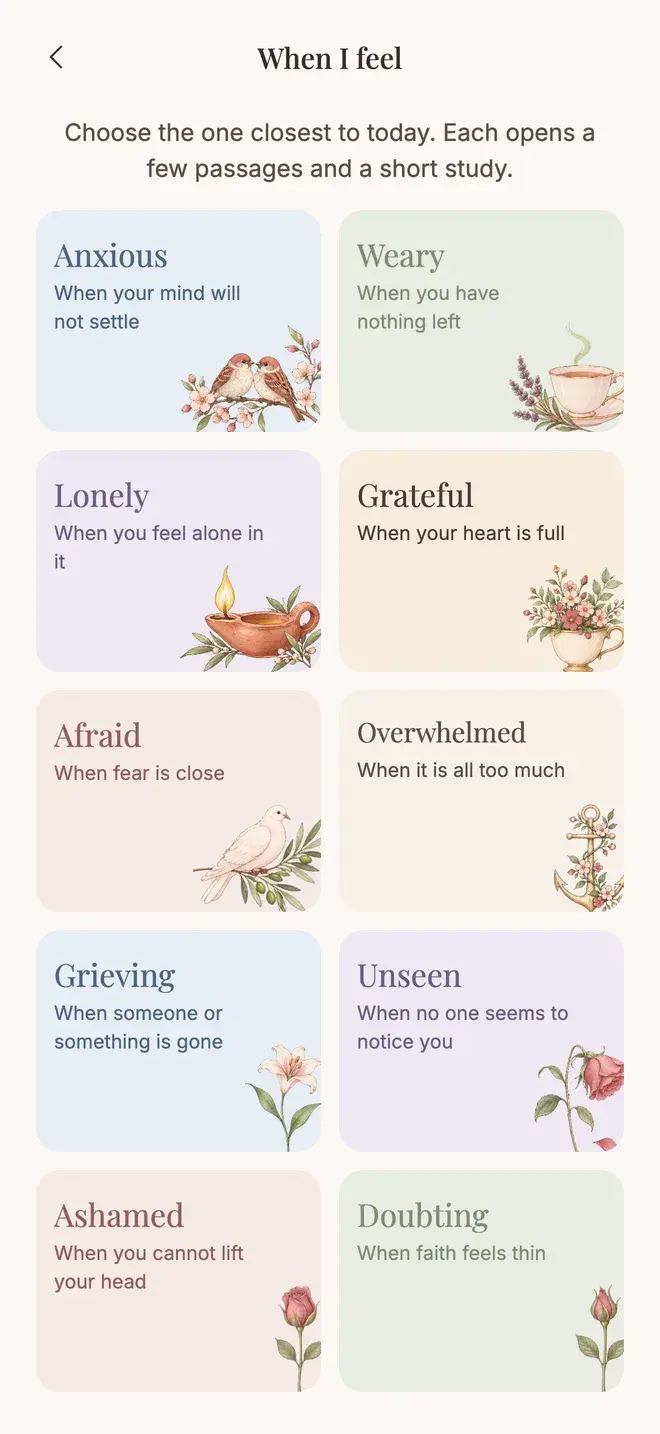
- Choose by season: grief, rest, friendship, work, anxiety, identity and more.
Ready-made Bible study plans
Each one is seven sessions on a single passage or book. Every session is available at 5, 10 or 20 minutes.
7 days · growing
Boundaries
A study in limits, honesty and rest
Protecting what matters, saying a plain no, and carrying only what is actually yours. Seven sessions across Proverbs, Matthew, Nehemiah, Mark, Luke, Galatians and Exodus, with a shorter or deeper route through each one.
7 days · growing
Courage to Speak
A study in courage and leadership
Courage grounded in who God is rather than in a guarantee, and truth spoken with care. Seven sessions across Joshua, Esther, Psalms, 2 Timothy, Acts, Ephesians and Daniel, with a shorter or deeper route through each one.
7 days · beginner
Friendship
A study in friendship and loyalty
Friendship as something done rather than only felt, including the honesty, patience and cost it involves. Seven sessions across Proverbs, Ecclesiastes, Ruth, John, Ephesians and 1 Samuel, with a shorter or deeper route through each one.
7 days · growing
Held
A study in grief and lament
Honest prayer, patient presence and a settled hope, for the seasons nobody chooses. Seven sessions across Psalms, Job, John, 2 Corinthians, Ecclesiastes, Lamentations and Revelation, with a shorter or deeper route through each one.
7 days · beginner
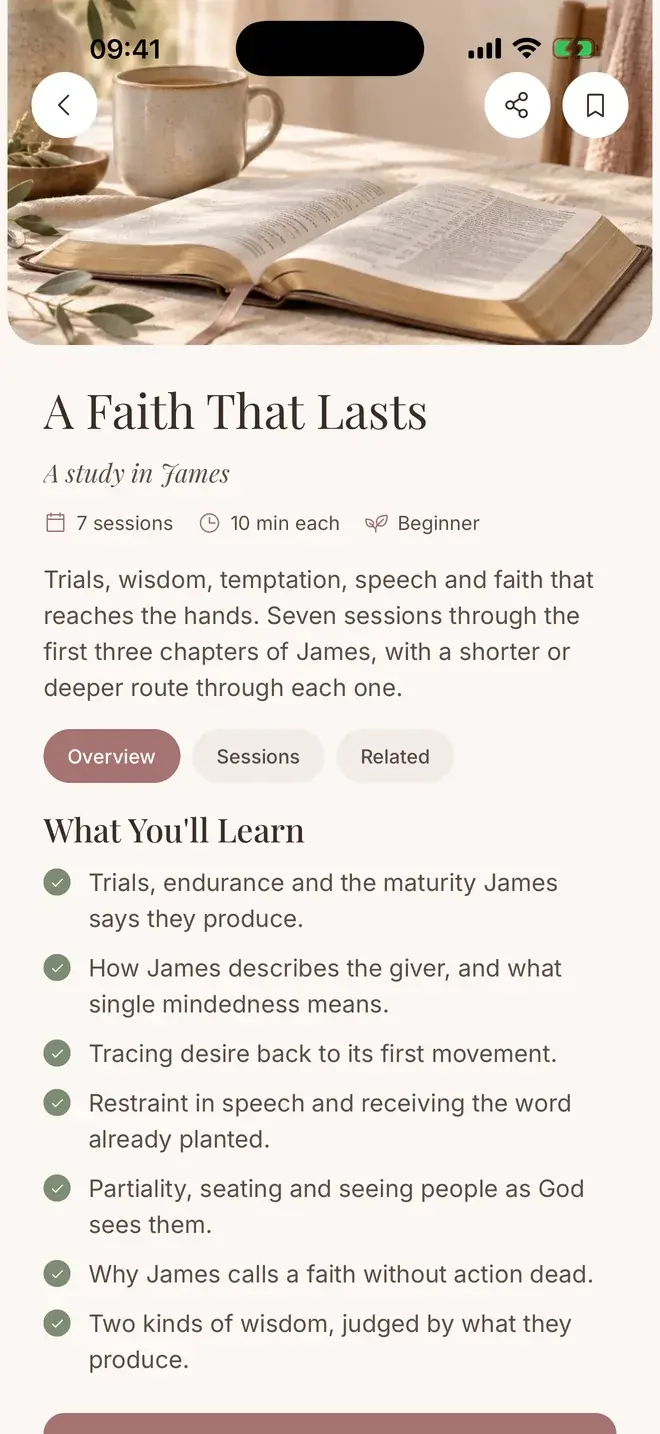
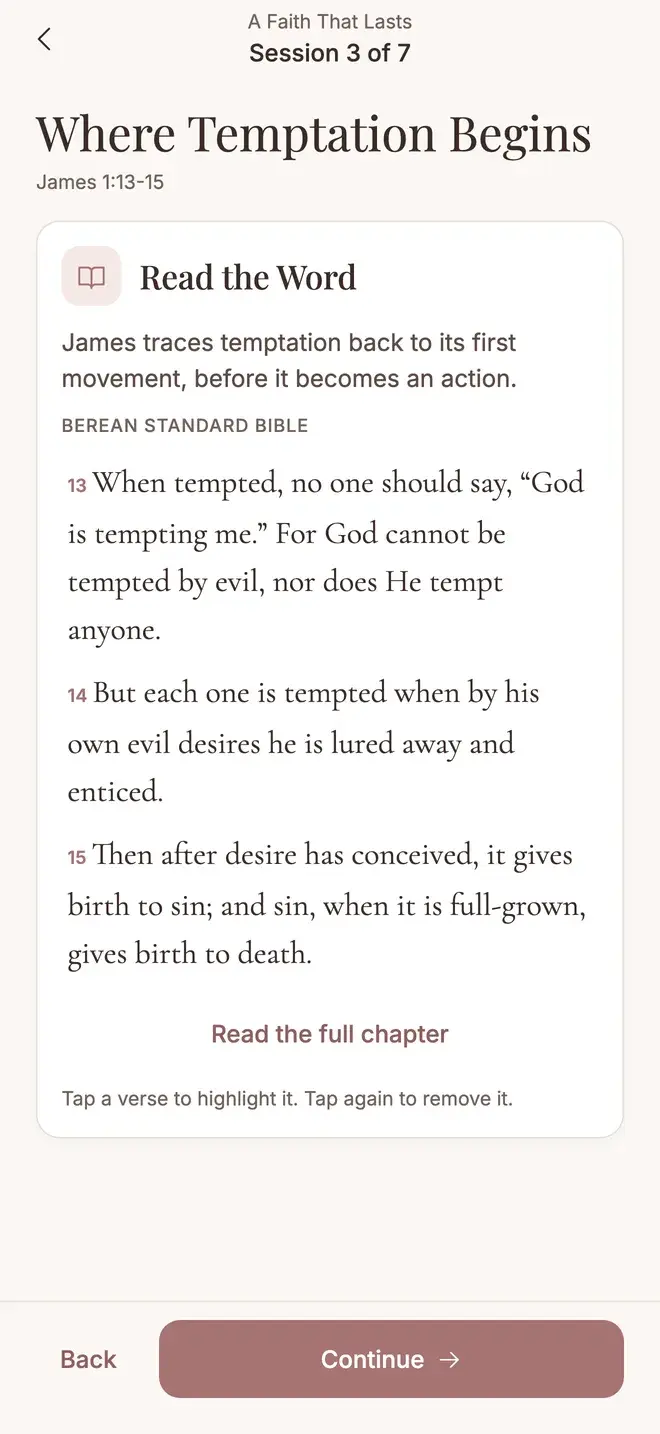
A Faith That Lasts
A study in James
Trials, wisdom, temptation, speech and faith that reaches the hands. Seven sessions through the first three chapters of James, with a shorter or deeper route through each one.
7 days · growing
A Household of Grace
A study in parenting
Formation over time rather than control in the moment, held alongside the reality that parents influence their children without determining them. Seven sessions across Psalms, Deuteronomy, Proverbs, Ephesians, 2 Timothy and 1 Samuel, with a shorter or deeper route through each one.
7 days · growing
Peace in the Chaos
A study in Philippians
Joy, prayer, attention and contentment, written by someone in prison to a community under pressure. Seven sessions through Philippians, with a shorter or deeper route through each one.
7 days · beginner
The Practice of Rest
A study in rest and quietness
Rest as part of the design rather than a reward, and quietness as strength rather than passivity. Seven sessions across Genesis, Exodus, Psalms, Mark, Matthew, Hebrews and Isaiah, with a shorter or deeper route through each one.
7 days · beginner
Rooted
A study in identity
Where identity comes from, and what it is for. Seven sessions across Psalms, Ephesians, 1 Peter, Romans, Galatians, Colossians and Matthew, with a shorter or deeper route through each one.
7 days · beginner
Ruth: The Whole Book
A whole-book study in four chapters
Loss, loyalty, provision and a genealogy nobody saw coming. Seven sessions through the whole of Ruth, with a shorter or deeper route through each one.
7 days · beginner
Giving Thanks
A study in gratitude
Gratitude in full seasons and empty ones: remembering the giver, naming what God has done, coming back to say thank you, and giving thanks inside hard circumstances. Seven sessions across Deuteronomy, Psalms, Luke, Daniel, Habakkuk, 1 Thessalonians and Colossians, with a shorter or deeper route through each one.
7 days · beginner
In the Waiting
A study in uncertainty
Trust when the road is not visible, and waiting that is active rather than passive. Seven sessions across John, Proverbs, Isaiah, Hebrews, Matthew and Psalms, with a shorter or deeper route through each one.
7 days · growing
Everyday Work
A study in work and calling
Work as a calling rather than a punishment, held alongside the reality of unfair pay, comparison and exhaustion. Seven sessions across Genesis, Colossians, 1 Corinthians, Ecclesiastes, James, Micah and Psalms, with a shorter or deeper route through each one.
Six Bible study methods compared
A plan tells you what to read. A method tells you what to do with it. Each of these works for a week or a season, and the worked examples below show each one on a real passage.
| Method | How it works | Time a session | Suits |
|---|---|---|---|
| SOAP | Scripture, Observation, Application, Prayer: four short written steps on one passage | 10 to 20 minutes | Beginners and busy mornings |
| Inductive | Observe, interpret, apply: read closely before drawing conclusions | 20 to 45 minutes | Readers who want to understand a passage thoroughly |
| Topical | Gather passages on one theme from across the Bible | 15 to 30 minutes, over a week | A season with a clear need or question |
| Character | Follow one person through every passage that mentions them | 15 to 20 minutes, over 3 to 7 sessions | Readers who love stories |
| Word study | Trace one important word through a passage and the wider Bible | 20 to 30 minutes | Curious readers who like detail |
| Book by book | Read one book from start to finish, a section at a time | 10 to 20 minutes a day, for weeks | Anyone ready for a longer plan |
The SOAP method
SOAP stands for Scripture, Observation, Application and Prayer. It is the simplest of the six, and it fits a notebook page.
S: Scripture
Read a short passage, then copy the verse that stands out by hand, with its reference.
O: Observation
Write two or three things you notice: who is speaking, what repeats, what it shows about God, what the verses around it add.
A: Application
Write one specific way the passage meets your life today. Keep it small and concrete.
P: Prayer
Write a short prayer that uses the words and ideas of the passage.
SOAP worked example: Philippians 4:4-7
About 15 minutes. Read the four verses twice before you write.
- Scripture
- Copy Philippians 4:6 from your Bible, with the reference.
- Observation
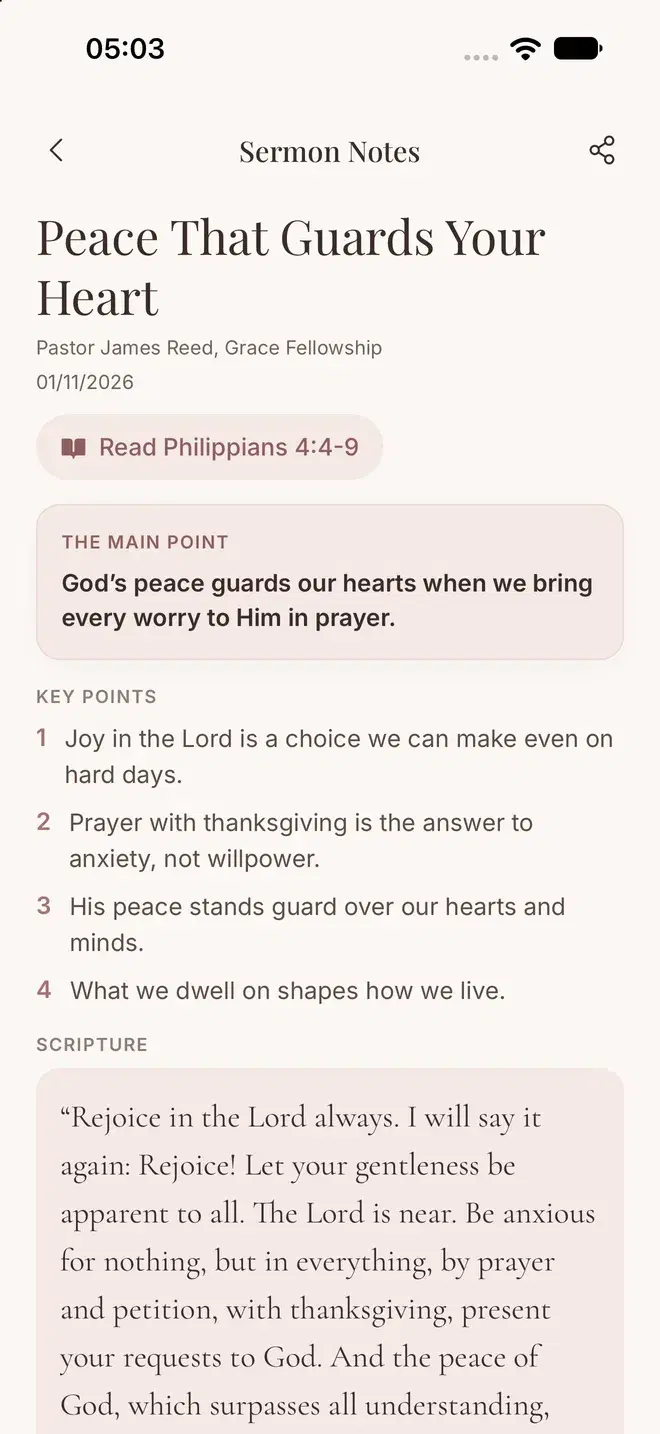
- Paul writes this from prison (Philippians 1:13). Rejoice is repeated in verse 4. Verse 6 sets prayer with thanksgiving against anxiety, and verse 7 says God's peace guards the heart and mind, like a soldier on watch.
- Application
- I am anxious about Thursday's appointment. Before I check my messages tomorrow, I will write the worry down as a request and add one thing I am thankful for.
- Prayer
- Lord, you are near. I bring you Thursday and what I am afraid of. Thank you for my sister's call. Guard my heart and my mind today.
- Time and fit
- Ten to twenty minutes. A good first method for beginners, and for any day with little time.
The inductive method: observe, interpret, apply
Inductive study works from the details of the text to its meaning, instead of starting with a conclusion. It takes longer and teaches you to read any passage well.
Observe: what does it say?
Read the passage several times. List who, what, where and when. Mark repeated words, contrasts, questions and connecting words such as for, but and therefore.
Interpret: what does it mean?
Ask why the author included this, and what it meant to the first readers. Read the surrounding chapter, compare a second translation and follow a cross-reference before you open a commentary.
Apply: what difference does it make?
Ask what the passage shows about God, what it asks you to believe, and one thing to do or stop doing this week.
Inductive worked example: Mark 4:35-41
Jesus calms a storm on the Sea of Galilee. About 30 minutes.
- Observe
- It is evening and Jesus chose the crossing (verse 35). The storm is violent and the boat is filling. Jesus is asleep on a cushion. The disciples wake him and ask whether he cares. He rebukes the wind, then asks about their fear and faith. Afterward they are more afraid than before and ask who he is.
- Interpret
- Mark ends on a question, so the passage is about who Jesus is. In the Old Testament it is God who stills the sea (Psalm 107:23-30). The disciples' second fear is awe at that discovery. Mark's first readers likely faced storms of their own, including persecution.
- Apply
- Jesus is in the boat with me, even when he seems asleep. This week I will bring the thing that frightens me to him in plain words, as the disciples did.
- Time and fit
- Twenty to forty-five minutes. Suits readers who want depth and are happy to go slowly.
Topical study worked example: rest
Choose a theme, gather five to eight passages from different parts of the Bible, read one a day, and write a summary at the end. A concordance or the search in a Bible app helps you find them.
- Day 1
- Genesis 2:1-3. God rests on the seventh day and blesses it. Rest is part of creation.
- Day 2
- Exodus 20:8-11. The Sabbath command, rooted in creation.
- Day 3
- Deuteronomy 5:12-15. The same command, now rooted in freedom from slavery in Egypt.
- Day 4
- Mark 2:23-28. Jesus says the Sabbath was made for people.
- Day 5
- Matthew 11:28-30. Jesus offers rest to the weary.
- Day 6
- Hebrews 4:1-11. A rest still ahead for God's people.
- Summary
- Rest is a gift, a sign of freedom and a promise. Christians practice it differently: some keep Saturday, many keep Sunday, and others treat the Sabbath as a principle of regular rest. A topical study notes these differences.
- Time and fit
- Fifteen to thirty minutes a day for a week. Suits a season with a clear question. Read each passage in its own context so the theme does not bend it.
Character study worked example: Deborah
Find every passage about one person, read them in order, and note what they did, what God did and what changed.
- Passages
- Judges 4 and Judges 5.
- Who she was
- A prophet who judged Israel, settling disputes under a palm tree in the hill country of Ephraim (Judges 4:4-5).
- What she did
- She summoned Barak and passed on God's command to fight. When Barak would go only if she came, she went, and said the honor of the victory would go to a woman (Judges 4:6-10). That woman turned out to be Jael.
- What God did
- He routed Sisera's army (Judges 4:15). The song in Judges 5 gives the credit to God.
- Questions
- Where do I wait for someone else to go first? What does her song teach about remembering what God has done?
- Time and fit
- Three to seven sessions of 15 to 20 minutes. Suits readers who love stories. Other good subjects are Ruth, Hannah, Esther, Peter, Mary Magdalene and Lydia.
Word study worked example: remain in John 15
Choose a word that repeats or carries weight, look it up, and trace how it is used. You do not need to read Greek or Hebrew: a concordance, an interlinear Bible or a Bible app with word lookup does the work.
- Passage
- John 15:1-11, the vine and the branches.
- The word
- Remain, in the BSB. The KJV says abide. Both translate the Greek verb meno, which means to stay, remain or dwell.
- Where it repeats
- Again and again in verses 4 to 10. That repetition tells you it is the center of the passage.
- Other uses
- In John 1:38-39 the first disciples ask Jesus where he is staying, and the same verb is used. Remaining in Jesus has the sense of staying with him and making a home with him.
- What it means
- Fruit comes from staying connected to Jesus, as a branch stays on the vine. The passage is an invitation to closeness before it is a demand for effort.
- Time and fit
- Twenty to thirty minutes. Suits curious readers. Check your conclusion against the whole passage, since a word study can be stretched too far.
Book-by-book worked example: James
Read one book from start to finish, a section at a time. Short letters make a good first book.
- Before you start
- Read a short introduction: James was likely written by the brother of Jesus, to Jewish believers scattered outside Israel. It has five chapters.
- Read it whole
- Read all five chapters in one sitting, about 15 minutes, to see its shape.
- Then a section a day
- Trials and wisdom (1:1-18), hearing and doing (1:19-27), favoritism (2:1-13), faith and works (2:14-26), the tongue (3:1-12), wisdom from above (3:13-18), pride and humility (4), patience and prayer (5).
- Each day
- Use SOAP or observe, interpret, apply on that section. Keep a list of repeated themes in the back of your notebook.
- At the end
- Write the book's message in two sentences, and choose the next book.
- Time and fit
- Ten to twenty minutes a day for one to two weeks for James, longer for bigger books. Suits anyone ready for a longer plan. Good next books are Mark, Philippians, Ruth and 1 Peter.
A sample week: Peace in the Chaos (Philippians)
Here is what a seven-day plan looks like day by day, from the Philippians study.
Day 1
Joy That Does Not Depend on Circumstances
Rejoicing in the Lord, and gentleness that shows.
Day 2
Anxious for Nothing
Prayer with thanksgiving, and the peace that guards.
Day 3
What You Dwell On
The list Paul gives for what fills the mind.
Day 4
Learning Contentment
Contentment as something practised, not a personality trait.
Day 5
Partners in the Gospel
Thanksgiving for people, and confidence in the one who began the work.
Day 6
Humility That Lifts Others
Counting others as more significant than yourself.
Day 7
Shining in a Difficult Place
Life without grumbling, and light that is visible.
How to build your own Bible study plan
Choose one focus
A single book (James, Ruth, Philippians) or a single theme (rest, courage, forgiveness). One focus per plan.
Set the length
Seven days is a good first plan. It is long enough to see a shape and short enough to finish.
Divide the passage
Give each day a paragraph or short chapter. A study of James has five chapters, so use one chapter a day and add two days to review and pray.
Use the same steps each day
Read it, look closely, ask what it shows about God, then respond in writing and prayer. The pattern is what makes it a study.
Plan the next one
Decide before the last day what you will study next. A plan with a gap after it rarely restarts.
Weekly Bible study plan template
Copy this into a notebook or a notes app.
- Focus
- The book or theme, and why you chose it.
- Days and time
- The days and the time you will study, such as Monday to Saturday at 6:30 a.m. Choose 5, 10 or 20 minutes.
- Each session
- Read the passage twice. Note one word that stands out. Write what it shows about God. Write one way to respond today. Pray.
- Day 7
- Read your notes from the week. Write a sentence on what changed. Choose the next study.
What makes a Bible study plan work
A plan works when it removes decisions. You do not choose what to read, how long to read, or what to do with it. Those answers are already on the page, and your energy goes to the Scripture.
A plan also fails when it is too big. Plans that ask for an hour every day get dropped on the first busy week. A plan sized for five minutes and extended on good days survives.
Look for plans that keep Scripture at the center, show where each passage sits in the Bible, and say where Christians read a passage differently. Plans that only offer opinion about the verse are less useful than ones that teach you to read.
In the app
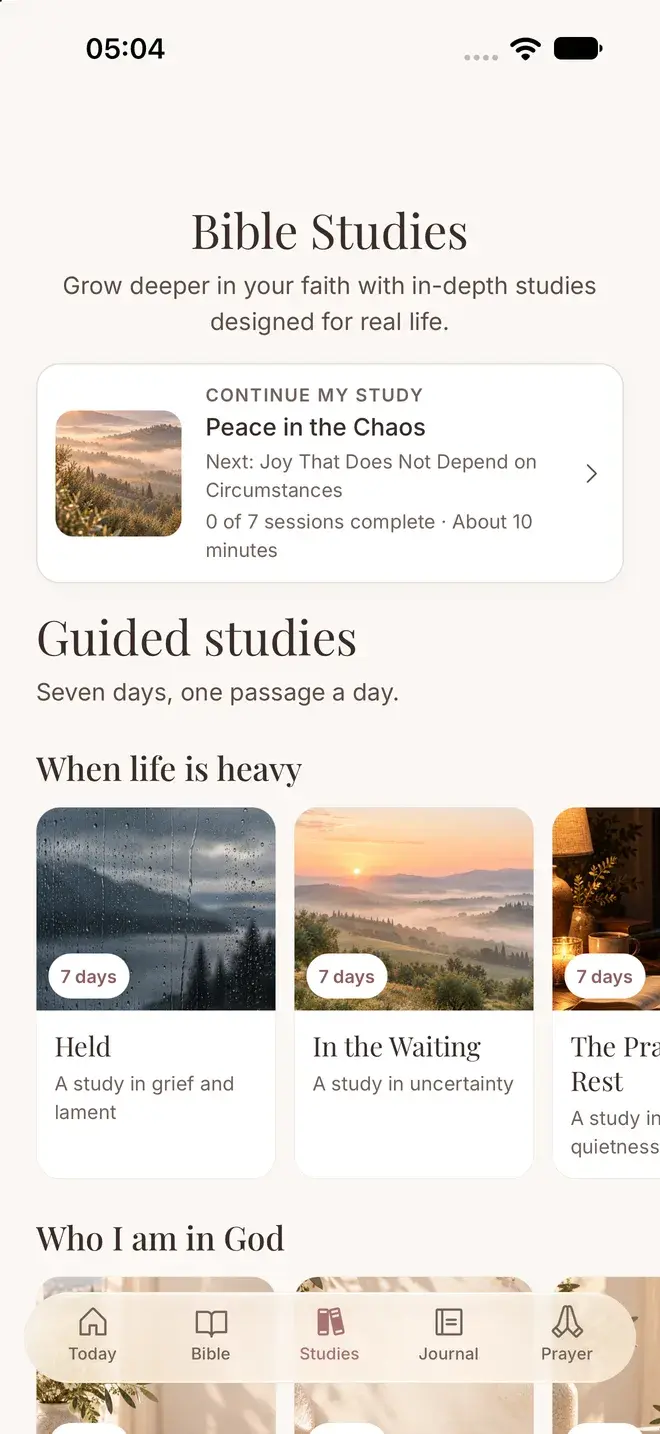
Bible study plans, built for you to finish
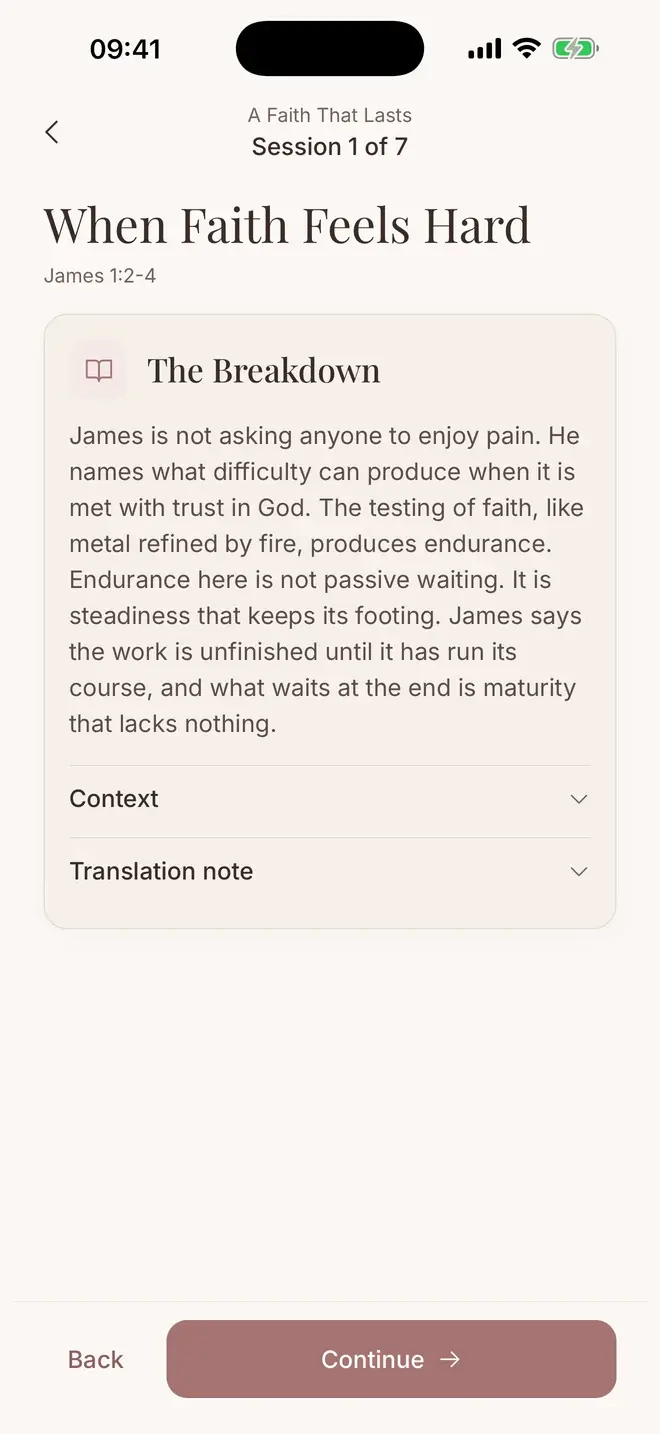
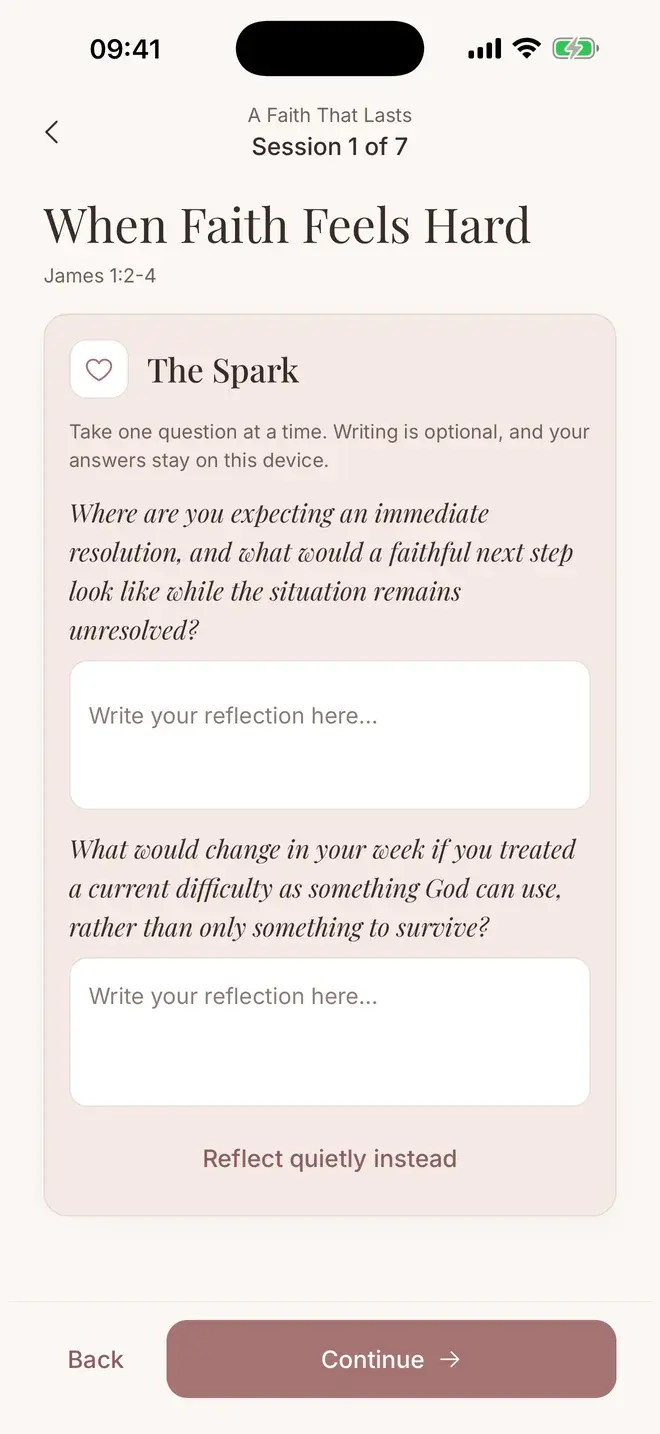
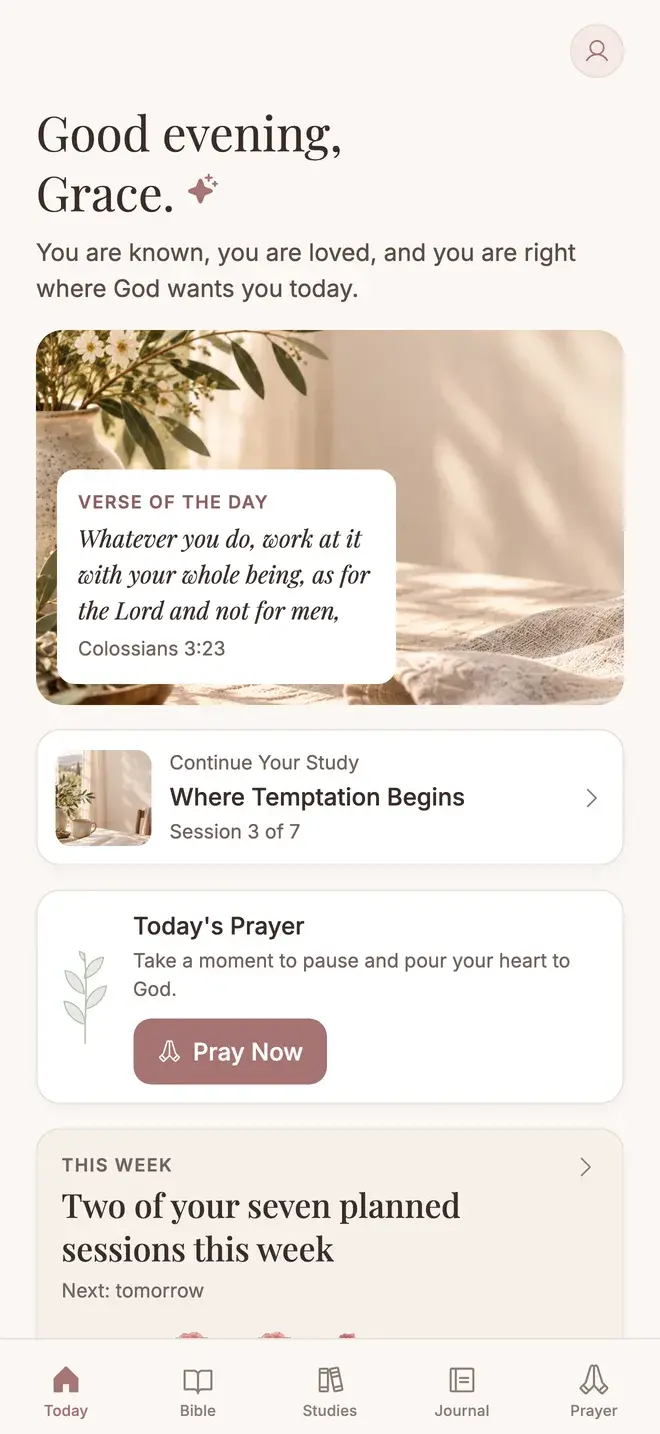
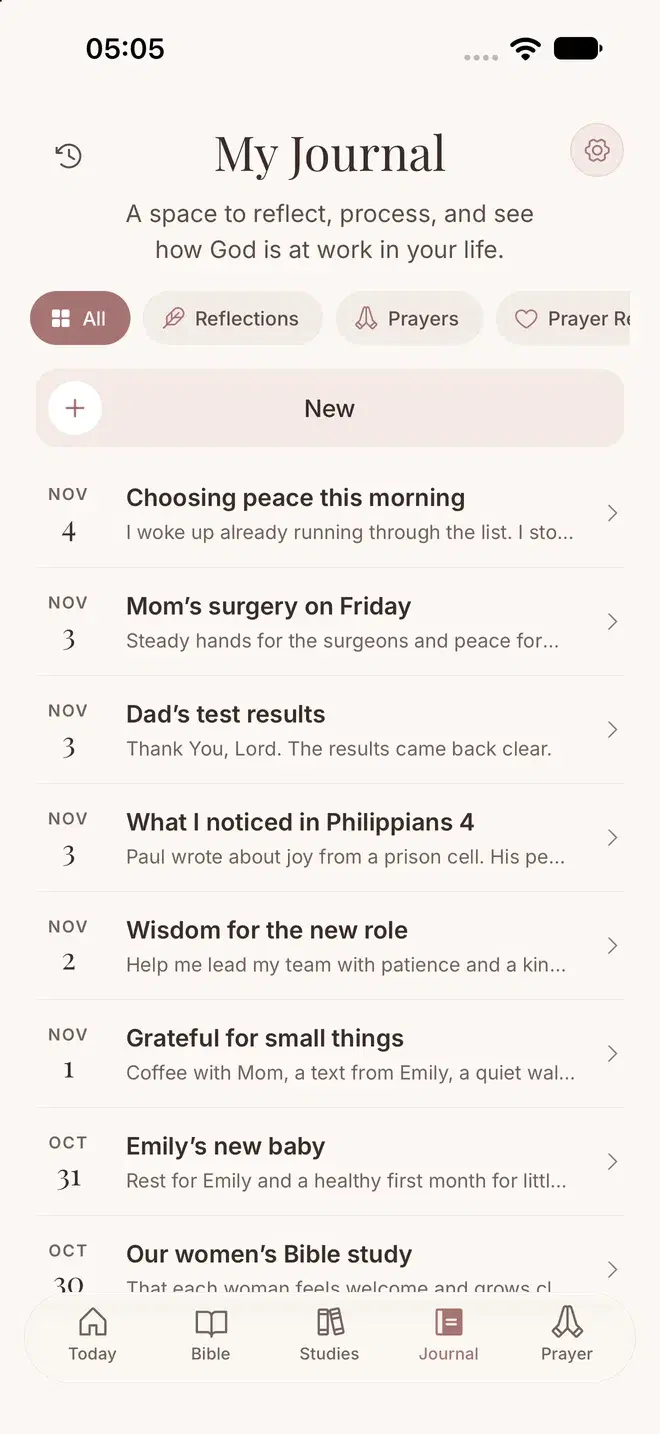
Every study in the Bible Studies for Women app is a seven-day plan with a passage a day. Each day follows six stages: Read, Look closely, The Breakdown, The Spark, Pray it through and Walk It Out.
Choose a daily, twice-weekly, weekly or fortnightly rhythm and the days of the week. A new seven-day study is released every month, and your notes stay in your private journal.
- Thirteen studies now, with a new study each month.
- Three depth routes (5, 10 or 20 minutes) through the same study.
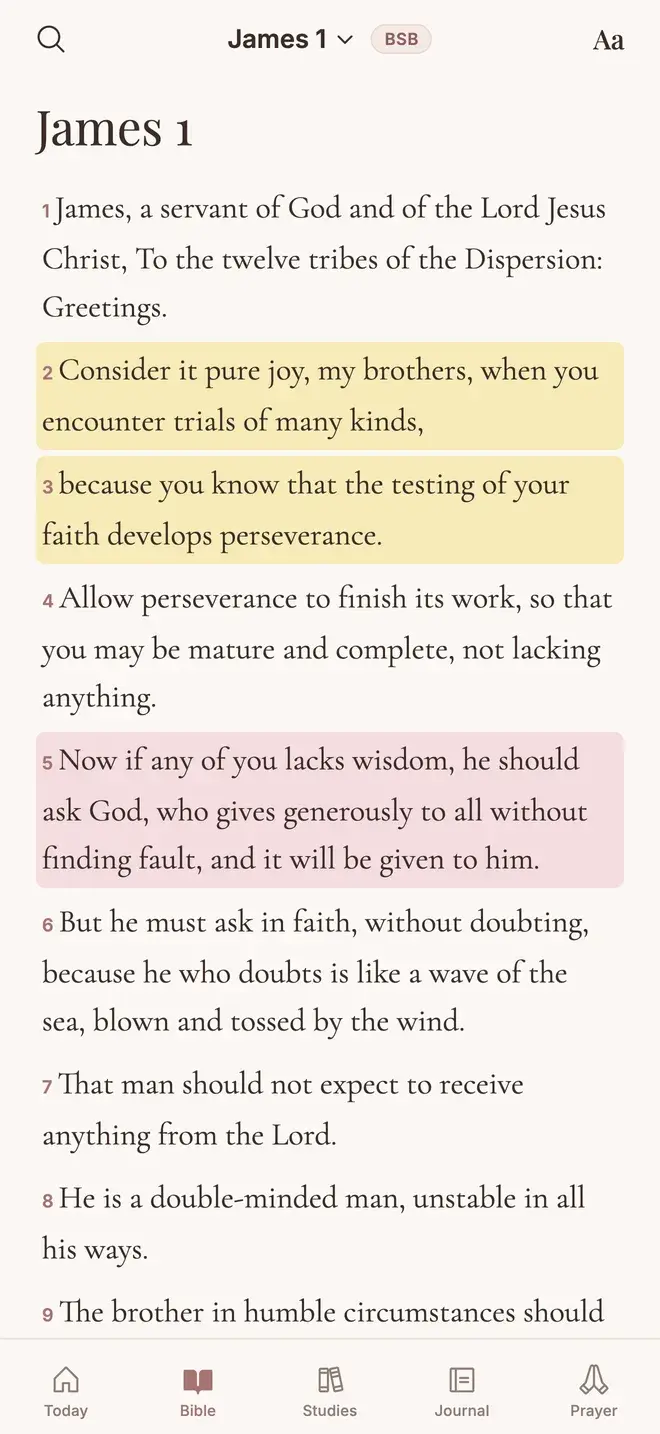
- The full Bible in BSB, WEB and KJV, offline.
- Where traditions differ on a passage, the study says so.